
modern
As the sandbanks shifted and Pakefield lighthouse was declared redundant and closed in 1864. The lighthouse’s 10m high tower has since been used as a war-time oservation post, store-room and holiday camp darkroom.
Added: 23 September, 2023
Early in 1903 construction started of the Tramway from Florence Road in Pakefield to Yarmouth Road in north Lowestoft. A spur was built along Denmark Road to the tramshed (still there)in Rotterdam Road. It was 3 ft 6 ins gauge, with the rails imported from Germany.
Added: 23 September, 20231881 Low Light now also flashes. And had to be moved 80 yards inland, because of erosion.
Added: 23 September, 20231974 the High Light is now fully automatic.
Added: 23 September, 20231872 - 74 The present High Light was built. It had a new optical revolving light, flashing at half-minute intervals.
Added: 23 September, 2023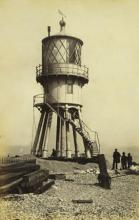
1923 Low Light extinguished, as the Stanford Channel was no more.
Added: 23 September, 2023
In the autumn of 1908 a hydroplane of the two-plane variety was tried with success on the Norfolk Broads, and over 20 miles per hour was reached with only 12 H.P. Surprise, as the little craft was named, was owned by Mr. M. Brooke, of Lowestoft, and had a length of 13 ft., with a 5 ft. 6 in. beam. She was built purely for experimental purposes, so did not take part in any of the public speed contests.
Added: 23 September, 2023Early in 1903 construction started of the Tramway from Florence Road in Pakefield to Yarmouth Road in north Lowestoft. A spur was built along Denmark Road to the tramshed (still there)in Rotterdam Road
Added: 23 September, 20231928 The bus service was extended to other areas, and in 1929 it was introduced along the route of the tramway.
Added: 23 September, 2023