
ENVIRONMENT
1735 Low Light moved because of changes to Stan(d)ford Channel
Added: 23 September, 20231706 the remaining Low Light ceased operation, possibly because "...the sea overwhelmed it..." (p97 Lights of East Anglia by Neville Long, 1983)
Added: 23 September, 2023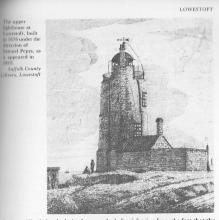
1676 Samuel Pepys was elected a Master of the Trinity Brethren, and immediately sanctioned a new Lowestoft lighthouse. A new Lighthouse tower was constructed, built of brick, this time on the cliffs. This became known as Lowestoft High Light. Trinity in its earlier records sometimes refers to the northernmost of the two Ness Point foreshore lights as the 'upper' light, which can be confusing.(drawing p93).
Added: 23 September, 20231670's The Lowestoft Lights were re-built again. A few years previously John Clayton had erected a coal-light a couple of miles north at Corton. Clayton's efforts to build lighthouses at various locations around the coast were seen by Trinity Brethren as being a threat to their monopoly.
Added: 23 September, 2023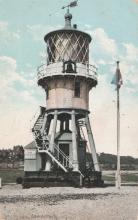
1867 A completely new Lowestoft Low Light, made of wrought iron. It was designed to be moveable.
Added: 23 September, 2023As the sandbanks shifted and Pakefield lighthouse was declared redundant and closed in 1864. The lighthouse’s 10m high tower has since been used as a war-time oservation post, store-room and holiday camp darkroom.
Added: 23 September, 20231850 Pakefield Light House moved to Kessingland because the channel had shifted. The Pakefield LH tower is still there, in the holiday centre. The light was finally extinguished in 1864.
Added: 23 September, 20231832 Pakefield Lighthouse (red light) built to help navigate through the channel between the Barnard and Newcombe Sands. The station was made of brick.
Added: 23 September, 2023