
Sea

Thirty-three years after she first prepared Lely’s Flagmen of Lowestoft for display, Senior Paintings Conservator Elizabeth Hamilton-Eddy prepares them for the Queen’s House.
credit: National Maritime Museum
Added: 23 September, 20231685 A sea survey by Greenville Collins showed the Standford Channel just off-shore (the name eventually contracted to the Stanford Channel).
Added: 23 September, 2023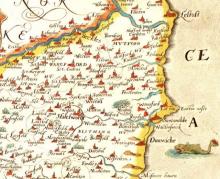
Christopher Saxton map showed Easton Ness as the most easterly point of Great Britain. Over the next decades, the action of the sea caused the salient to migrate north, to Lowestoft Ness.
Added: 23 September, 20231706 the remaining Low Light ceased operation, possibly because "...the sea overwhelmed it..." (p97 Lights of East Anglia by Neville Long, 1983)
Added: 23 September, 2023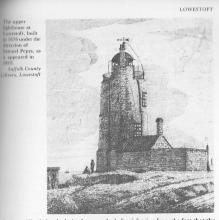
1676 Samuel Pepys was elected a Master of the Trinity Brethren, and immediately sanctioned a new Lowestoft lighthouse. A new Lighthouse tower was constructed, built of brick, this time on the cliffs. This became known as Lowestoft High Light. Trinity in its earlier records sometimes refers to the northernmost of the two Ness Point foreshore lights as the 'upper' light, which can be confusing.(drawing p93).
Added: 23 September, 20231670's The Lowestoft Lights were re-built again. A few years previously John Clayton had erected a coal-light a couple of miles north at Corton. Clayton's efforts to build lighthouses at various locations around the coast were seen by Trinity Brethren as being a threat to their monopoly.
Added: 23 September, 20231735 Low Light moved because of changes to Stan(d)ford Channel
Added: 23 September, 2023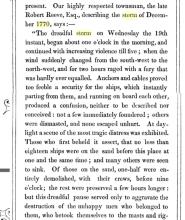
Huge storm. On the coast between Yarmouth and Southwold thirty ships and 200 lives were lost. Eighteen vessels washed up on Lowestoft beaches.
Added: 23 September, 2023