
High Street Buildings - Surviving Internal Timber-framing
Overview and Commentary
On 12 May 1545 Thomas Howard, Duke of Norfolk (and third of his family to hold the title), visited Lowestoft as part of a survey being carried out to ascertain the state of East Coast sea defences, in anticipation of a possible invasion by French and Scottish forces. This is what he had to say about the town. “At Laystofte [sic], for small ships of 10 or 12 foot draught, are two very good roads [inshore anchorages] called the North Road and the South Road, in either of which a good number of mean ships [small to average size] may ride against all winds. Between the landing place and the town is at least forty score tailor’s yards [960 yards, in all], and the landing place is more than half a mile in length. The town have made bulwarks [gun emplacements] of earth at each end of the road, and in the middle, with three or four small pieces [cannon] in each. The town is as pretty a town as I know any few on the sea coasts, and as thrifty [reliable] and honest people in the same, and right well builded; but surely if an army royal [large and powerful] should come thither, considering the bulwarks, which should beat [traverse] the road, be but of earth, as banks made of turves, and so far distant from the town, I think it should be no great adventure [risk] for a good puissance [force] to land there and burn the said town.”
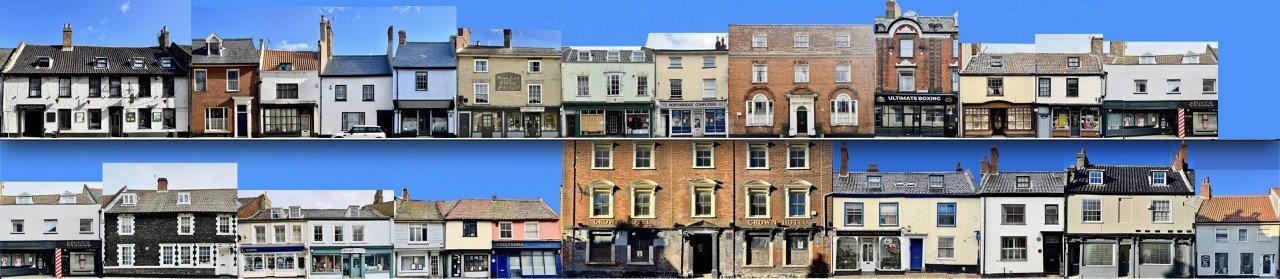
See SKYLINE filtered to JUST show timber-framed buildings and ones containing remnants of such construction.
See individual timber-frame building details
Thomas Howard’s concerns are clear. The gun batteries had earth-and-timber surrounds (rather than masonry or something substantial) and were situated more than half a mile from the town - the width of the Denes probably having been measured from Whapload Road. This would have enabled a sizeable force to sail in between the gun positions - the range of the cannon (known as slings) being about half to three-quarters of a mile with round shot made from limestone about the size of a tennis ball - then, land on the beach and sack the town. What is of primary interest, here, are the remarks he made about Lowestoft as a place and its inhabitants - especially, within the context of this piece. “As pretty a town as I know any few on the sea coasts…and right well builded.” Two of the houses he would have seen in May 1545 are still with us today: Nos. 36 and 102-104 High Street - the former dating from the late 15th century and the latter from c. 1520-30. Fishing (together with the curing of herrings, particularly) and maritime trade - around the coasts of England and also in the Baltic and Mediterranean seas - had brought wealth to the town. And it showed - especially in the dwellings along the High Street belonging to families of the merchant class.
Significantly, however, the two surviving buildings referred to are not fully timber-framed. That is, from the ground upwards, starting on a large horizontal timber known as a sole-plate which was usually raised a little above ground-level on courses of brick or consolidated rubble. Both of them are half-timbered, with a ground floor built of masonry and a first floor constructed of wooden studs (with varying infill between) resting on a timber wall-plate. A timber-framed roof, consisting of a series of trusses then surmounts what lies below, resting on another wall-plate and mainly thatched with reed to begin with - this material being replaced by tiles later on to reduce fire-risk. In order for rainwater to run off thatch satisfactorily, the pitch of a roof needs to be about 60 degrees and there are a number of buildings on the High Street which have this characteristic to reveal earlier origins than may at first appear visible. A further sign of a roof having previously been thatched is where there is a noticeable gap between tiles and the upper edge of a gable - this particular space representing the width of thatch once placed there.
Why, then, given the degree of wealth in the town during the 15th and 16th centuries, were there not fully timber-framed houses in Lowestoft - such as can be seen surviving in other towns of the time? The answer is simple. The parish did not have a sufficient area of managed woodland to produce what was needed for house construction - let alone for the ship- and boat-building activity taking place. Oak was what was required; and, with most of the soil being light and acidic, this could not be grown successfully on a large enough scale. According to a very detailed Manorial Survey of 1618, there were only about twenty to twenty-five acres of managed woodland present (twelve of which were located on the Akethorpe Estate, which belonged to Magdalen College, Oxford) - with it being almost totally located in the north-western sector of the parish where heavier soils were to be found. And this is why the town almost certainly had to look to other sources of oak in order to provide what was needed for both the construction of houses and of sea-going craft both large and small.
The question then arises as to where such timber came from, and there are a number of possibilities. In Lothingland itself, and not too far from Lowestoft, both Somerleyton and Lound had substantial areas of managed woodland and are likely to have been sources of supply. Then, in Mutford Half-hundred - and again not too far away - there was the parish of Mutford itself, with its Great Wood and Little Wood under productive management. While going a little further afield, but still reachable there and back within a day’s travelling-time, there was Sotterley (Wangford Hundred) and Reydon (Blything Hundred). The Sotterley Estate was used as late as the 1920s to source timber to build wooden steam drifters in Lowestoft, while Reydon Wood is mentioned as a source of supply of coppiced ash and oak billets for the curing of red herrings in probate material of the late 16th century, and is likely to have been producing building timber as well. There would undoubtedly have been other areas of woodland, in other places, called upon - but a number of obvious ones have been cited here. CREDIT:David Butcher
United Kingdom
Add new comment